
Choosing the Best Smart Outdoor Lighting for Your Home
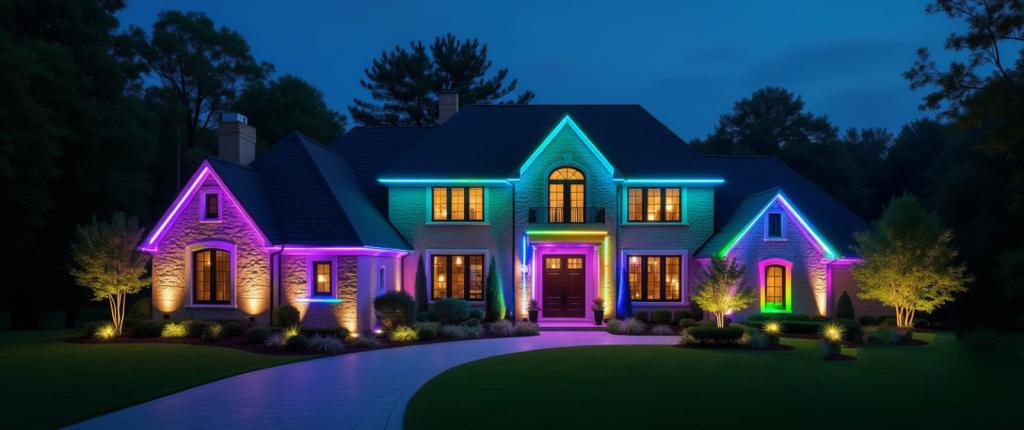
Have you ever wondered how you can make your outdoor space as “smart” as your home? With smart lighting, door locks, and security cameras becoming a standard, it’s no surprise that many people are turning their attention to smart outdoor lighting systems for their gardens and backyards. But with so many options and technologies available, choosing the right system can be overwhelming.
· What’s the difference between Wi-Fi, BLE, Zigbee, Thread, and Matter
· How can I make my lights turn on automatically when someone walks by?
· Do I need to buy a hub?
· Which brands will actually work with my system?
Many outdoor lighting articles focus on basic wiring and brightness levels but miss the crucial topic: how to make your outdoor lights truly smart. While some articles review products, they often leave out the technical understanding of what makes a light “smart.” This guide dives into the essentials of smart outdoor lighting: how it works, the innovations it brings, compatibility across ecosystems, and what you should really focus on when choosing your system.
What is Smart Outdoor Lighting
More Than Just Control via an App
Smart outdoor lighting isn’t just about controlling your lights with an app. It’s about integrating them into your lifestyle to enhance convenience, safety, and ambiance. Here’s how smart outdoor lighting can change the way you interact with your space:
Voice Control
When your hands are full, you can use voice commands to control your outdoor lighting:
“Alexa, turn on the backyard lights.”
“Hey Google, dim the pathway lights to 30%.”
“Hey Siri, set the landscape lights to warm white.”
Automatic Lighting When You Arrive
Your lights become your welcoming committee
· Geofencing: Your phone’s location can trigger lights to turn on as you approach.
· Action Triggers: When the garage door opens or your smart lock unlocks, the lights illuminate the driveway and front porch.


Enhanced Security Mode
Increasingly popular in North America, this feature boosts safety by making your outdoor space more responsive:
· Cameras detect movement → Backyard lights brighten instantly.
· The doorbell senses motion → Lights flash to alert you.
· Sensors detect movement in the yard → Lights turn on automatically.
Holiday Lighting
Celebrate in style with customizable RGB lights for holidays like Christmas, Halloween, and Independence Day, even syncing with music for a dynamic display.

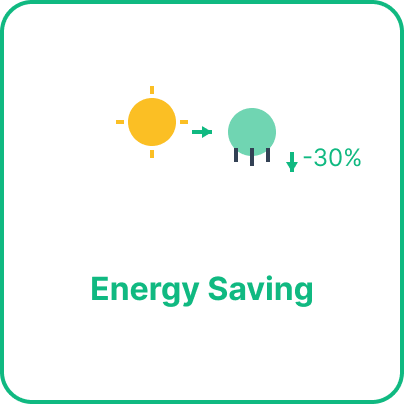
Energy Efficiency
Smart lights adjust automatically to save energy:
· Lights turn on at sunset, dim at night, and shut off at sunrise.
· Adjust brightness based on environmental conditions, reducing energy consumption.
Three Core Concepts
You Need to Know First
Before diving into the details, let’s break down the three fundamental components of smart outdoor lighting:

Communication Protocol
The “Nervous System” of Your Lighting
This defines how signals are transmitted between devices, affecting the stability and speed of connections.

Smart Scenes
The “Brain” of Your Lighting
This allows lights to sense your needs and act autonomously, turning your lighting into a truly smart system.

Ecosystem
The “Ecosystem” for Your Devices
This determines how well your outdoor lights will integrate with other smart home devices to create a synchronized experience.
Communication Protocol
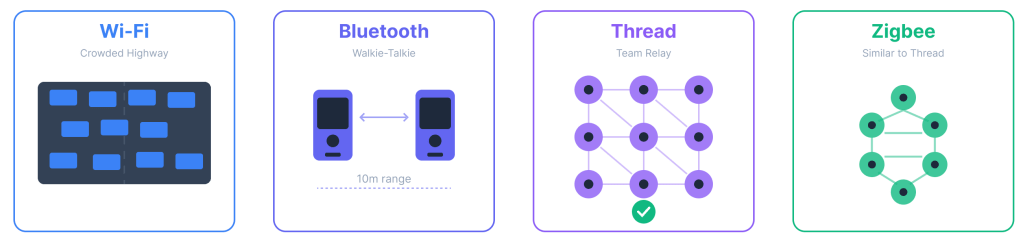
Smart outdoor lighting operates on different communication protocols. Here’s a quick comparison:
Wi-Fi
- Metaphor: Like the main road outside your house—high bandwidth and fast speeds, but when there’s heavy traffic (many devices connected), it can slow down. Plus, if you live far down a street, the signal might not reach your backyard (poor wall penetration).
- Advantages:
- Simple Setup: Uses your home’s existing Wi-Fi, so no extra equipment is needed.
- Fast Speeds & High Bandwidth: Provides high-speed internet for quick connections.
- Disadvantages for Outdoor Smart Lighting:
- Limited Range: Wi-Fi signals weaken through walls, leading to dropped connections when the signal is weak or unstable.
- Device Connection Limits: Home routers can only reliably connect a limited number of devices (typically 20-25 on a 2.4GHz network).
- Network Dependency: If your home Wi-Fi goes down or the router resets, all your lights will lose connection.
- High Power Consumption: For solar or battery-powered lights, this is a significant drawback.
- Networking Cost:
- Theoretical: No extra gateway needed.
- Practical: Wi-Fi signals have trouble reaching outdoor areas, so you may need to buy a mesh Wi-Fi extender for larger yards.
- Related Products/Brands:
- Govee Outdoor Spotlight (Wi-Fi & Bluetooth)
- Eufy Permanent Outdoor Light (Wi-Fi & Bluetooth)
- Ring Floodlight
- LIFX Permanent Light/Path Light
Bluetooth / BLE Mesh
- Metaphor: Like a walkie-talkie—great for short distances, but it won’t work well if you’re too far away.
- Advantages:
- Low Power: Consumes very little energy.
- Direct Point-to-Point Connection: Easy to connect between devices directly.
- Disadvantages for Outdoor Smart Lighting:
- Extremely Short Range: Bluetooth typically has a stable connection range of about 10 meters, which makes it difficult to cover a large yard.
- Poor Penetration: Walls, trees, or other obstacles can block the signal.
- Point-to-Point Communication: Requires a gateway to enable remote control and cross-platform integration.
- Networking Cost:
- Needs a gateway (such as a smart speaker or dedicated hub) to bridge Bluetooth and Wi-Fi networks for remote control and integration with other devices.
- Related Products/Brands:
- Govee Outdoor String Lights
- Govee Outdoor Spot Lights
- Nanoleaf Outdoor String Lights
Thread
- Metaphor: Like a team passing messages hand-to-hand—more devices mean better coverage, and one team member’s break doesn’t slow the others down. It runs quietly in the background (low power) and reacts instantly when needed (low latency).
- Advantages:
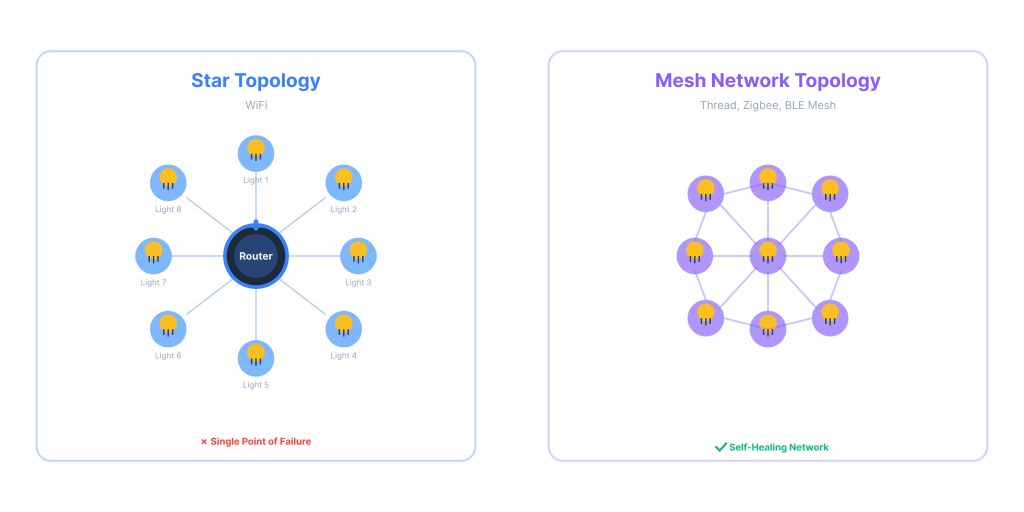
- High Stability: With a mesh network, the failure of one device doesn’t impact others. More lights make the network more stable.
- Wide Coverage: In a typical home yard, the range can be 10-100 meters, and the signal can be relayed from one device to another.
- Extremely Low Latency: Lights react almost instantly when triggered.
- Seamless Connectivity & IPV6 Support: Can bridge with Wi-Fi and other IP networks, and supports the Matter standard.
- Local Control: Works even if your Wi-Fi goes down.
- Ultra-Low Power Consumption: Ideal for battery-powered devices.
- Disadvantages for Outdoor Smart Lighting:
- 2.4GHz Band Interference: Can cause interference with Wi-Fi and Bluetooth devices. Avoid placing near large interference sources like routers or microwaves.
- Networking Cost:
- Requires a Thread Border Router (like Apple’s HomePod Mini, Nest Hub, or brand-specific routers). Many modern smart devices already have this feature built in.
- Related Products/Brands:
- Yeismooi Smart Outdoor Spotlight
Zigbee
- Metaphor: Similar to Thread, but with a slightly different setup.
- Advantages:
- High Stability: Mesh network makes it more stable as more devices are added.
- Wide Coverage: Effective in large areas.
- Low Latency: Lights turn on quickly with minimal delay.
- Low Power: Great for battery-powered devices.
- Local Control: Can work without cloud services, so it’s reliable even when Wi-Fi goes down.
- Disadvantages for Outdoor Smart Lighting:
- 2.4GHz Band Interference: Similar to Thread, Zigbee can experience interference with other devices using the same frequency.
- Brand Compatibility Issues: Different brands may not be fully compatible, requiring specific bridges.
- Networking Cost:
- Needs a Zigbee Bridge (e.g., Philips Hue Bridge). Without it, devices can’t communicate with each other.
- Related Products/Brands:
- Philips Hue Outdoor Lights
Why We Recommend Thread and Zigbee
Thread and Zigbee are ideal for larger outdoor spaces because of their mesh networking capabilities. As you add more lights, the system gets more stable. Thread is seen as the future of smart homes because it supports the Matter standard and integrates seamlessly with Wi-Fi and other networks. Zigbee is a proven protocol with extensive device options and a mature ecosystem.
Why Not Wi-Fi?
While Wi-Fi may seem convenient due to its simplicity, it struggles in outdoor environments where signal strength decreases. With more devices, your router may experience slowdowns, and for solar-powered lights, Wi-Fi can be energy-hungry.
Why Not Bluetooth/BLE Mesh?
Bluetooth has limited range and requires a gateway for remote control. It’s not the best choice for covering large yards or creating a fully automated system.
Smart Scenes
The Soul of Smart Outdoor Lighting

The key to smart outdoor lighting is creating automated scenes based on specific triggers. These triggers fall into four categories:
Time-Based Triggers
· Auto-turn on/off based on sunrise/sunset.
· Schedule dimming at night for energy savings.
Behavior-Based Triggers
· Lights turn on when your phone is near.
· Lights turn on when a door unlocks or the garage opens.
Environment-Based Triggers
· Light sensors detect darkness and turn on lights.
· Weather-based triggers adjust brightness based on cloud cover.
Scene Modes
· Pre-set modes like “Reading,” “Relax,” or “Party.”
· Dynamic RGB lighting effects for holidays and special occasions.
Ecosystem Compatibility
The Importance of Integration

For your smart outdoor lighting to work seamlessly, it needs to integrate with the rest of your smart home. Each platform has its strengths and limitations when it comes to automation. Choosing a system that works well with your existing devices is essential for maximizing convenience.
Ecosystem
Core Strengths
Main Limitations
Apple HomeKit
- Precise Local Automation: Automation based on location (geofencing) and time triggers.
- Privacy and Security: Strong focus on privacy, with all data processed locally.
- Seamless Integration: Deep integration with HomePod and Apple TV for a smooth experience.
- Strict Device Certification: Fewer compatible brands and products.
- Limited Cross-Brand Automation: Complex automation across different brands can be difficult.
Amazon Alexa
- Security Integration: The leader in security system integration, with mature partnerships with Ring, smart locks, and cameras.
- Powerful Routines: Supports complex logic (IF/AND/OR) for creating custom routines.
- Wide Device Support: Works with a broad range of brands and devices.
- Cloud-Dependent Automation: Relies on cloud connectivity, so some functions may fail if the internet is down.
- Limited Deep Control of Non-Audio Devices: While excellent for audio devices, Alexa may have limited control over other types of smart devices.
Google Home
- Flexible Automation Scripts: Highly customizable automation scripts for more complex setups.
- Seamless Integration with Nest: Excellent integration with Nest cameras for home security.
- Precise Environmental Triggers: Leverages Google’s API for more accurate environmental assessments, such as weather-based adjustments.
- Closed Automation Ecosystem: Less flexible in supporting third-party services compared to other ecosystems.
- Best for Smart Displays: Provides the best experience with smart displays; pure voice control is not as refined.
SmartThings
- Most Powerful Automation: Supports complex, multi-condition automations with regional triggers.
- Wide Compatibility: Extensive support for niche protocols and third-party devices, making it highly versatile.
- Cloud Dependency: Relies on Samsung’s servers, which may introduce potential delays in cloud-based automation.
- Steep Learning Curve: More complex interface with a steeper learning curve for beginners.
Matter: The Unified Language Across Ecosystems
What is Matter?
Matter is not a new communication protocol but a smart home interconnectivity standard built on existing protocols. You can think of it as a universal translator or a common language that devices from different brands use to “speak” to each other. Matter standardizes the way devices communicate, ensuring seamless compatibility across brands.
How Matter Relates to Communication Protocols
Matter operates on top of existing communication protocols. In simple terms, think of Thread and Wi-Fi as the “highways” that carry the data, while Matter is the “traffic rules” that make sure all devices (the “vehicles”) are correctly identified and can interact properly. For smart outdoor lighting, Matter is implemented in two main ways:
- Matter over Thread: This is the ideal setup. Lights connect using the low-power, high-stability Thread Mesh network and communicate with different platforms via the Matter standard.
- Matter over Wi-Fi: Some high-performance lights (like powerful spotlights) may connect directly over Wi-Fi and still follow the Matter standard.
What Does This Mean for You?
Choosing Matter-compatible outdoor lights gives you the greatest freedom in ecosystem compatibility. A Matter-enabled light can seamlessly integrate with Apple Home, Amazon Alexa, Google Home, and more, without worrying about being locked into a specific brand. It’s the key to realizing the future vision of “one app controls everything.” However, keep in mind that some users have noted that while Matter ensures broad compatibility, it can sometimes limit the depth of control over certain features, like customizing specific dynamic lighting effects.
Choosing the Right Smart Outdoor Lighting
Connection Stability (Dropout Rate)
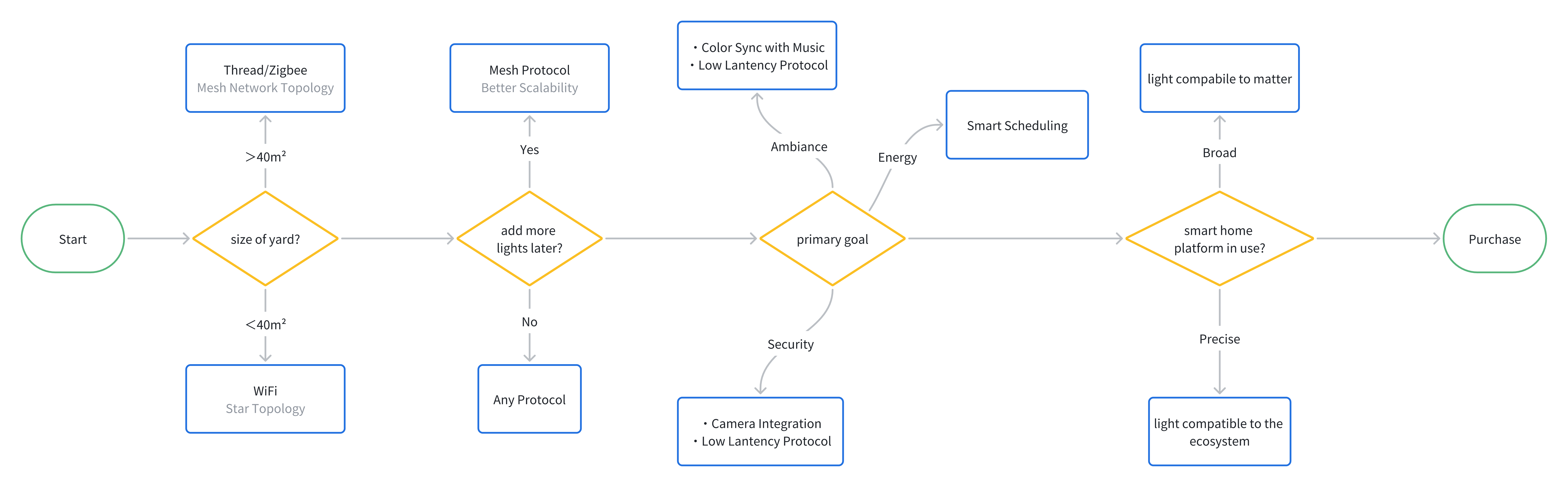
This is the most overlooked but crucial metric in smart lighting systems. For your lights to work effectively, they need to stay in constant communication with your smart platform. If the protocol is unstable, you might face issues such as: inability to control the lights, automation not triggering as expected.
Outdoor environments amplify these problems because of greater distances, more walls, and increased electromagnetic interference.
Stability Rankings (based on user experience):
Thread ≈ Zigbee > BLE Mesh > Wi-Fi
Smart Control Response Time (Latency)
The speed of response is crucial to your experience. If you’re setting up automation like “security lighting triggers” or “party light effects” low latency is a must. Here’s how different communication protocols perform in terms of latency:
- Wi-Fi: Moderate (slows down during network congestion)
- BLE (Bluetooth Low Energy): Moderate
- Zigbee: Fast
- Thread: Very fast (closest to “instant response”)
Multi-Device Expansion Capability (Important for Large Yards)
Many people think “more lights = more hassle,” but with mesh technology, the opposite is true. In Zigbee and Thread networks, the more lights you add, the more stable the network becomes. With Wi-Fi, however, the opposite happens: More lights → More pressure on the router → Increased latency → More frequent dropouts.
If you plan on setting up a full system (front yard, side yard, backyard, driveway), expansion capability should be one of top priorities.
Smart Capabilities
Many brands focus on basic features like adjusting brightness, color temperature, and switching colors. While these are digital (basic adjustments), true smart lighting goes beyond that. Depending on your lighting goals, here’s what to consider:
- Security goal: Can your lights work in tandem with security cameras and smart locks to turn on or off automatically?
- Energy-saving goal: Do the lights adjust brightness based on ambient light, time of day, and nearby movement?
- Atmosphere goal: Can the lights sync with surrounding moods, such as adjusting colors to match the vibe?
Ecosystem Compatibility and Cross-Platform Adaptability
It is suggest to integrate your smart outdoor lights into your smart home ecosystem for maximum convenience. When selecting smart outdoor lights, ensure the products are compatible with your platform in use. Common IoT platforms include HomeKit, Amazon Alexa, Google Assistant, and SmartThings. If your devices are from various brands, Matter will make things easier in the future.
Overall Cost (Beyond the Price of the Lights)
Different protocols require additional equipment, which impacts the final cost. Here’s a breakdown:
Wi-Fi
· Additional cost: Possibly a Wi-Fi extender
· Why: Wi-Fi signals weaken significantly when they pass through walls, especially in larger outdoor spaces.
BLE / BLE Mesh
· Additional cost: Must buy a gateway
· Why: To enable full smart control, you need a gateway to bridge BLE devices with your network.
Zigbee
· Additional cost: Requires a bridge
· Why: Zigbee devices need a bridge (e.g., Philips Hue Bridge) to communicate with each other.
Thread
· Additional cost: Requires a Thread Border Router
· Why: To connect Thread devices to your network and the internet, you need a compatible router (e.g., HomePod Mini, Nest Hub).
Trends to Watch
The Future of Smart Outdoor Lighting:
Matter as a Universal Standard
Devices will no longer be restricted to specific ecosystems. With Matter, a light can freely connect to Apple, Google, or Amazon platforms without compatibility issues.
Thread Networks
As more smart home hubs (like the HomePod Mini and Nest Hub) support Thread, creating a stable, low-power network for outdoor lights will become easier than ever.
AI-Driven Automation
Lights will learn your routines and automatically adjust, creating more intuitive lighting experiences without the need for complex setups.
Lighting as the First Line of Defense
Lighting becomes an “active defense” system. By combining camera footage with AI to detect people, animals, or vehicles, your lights can act as a deterrent, becoming an integral part of your home security system.
Smarter, Greener Lighting
Enhanced sensors and AI algorithms will maximize energy efficiency, while reducing light pollution and conserving resources.
Cost-Effective and Convenient Upgrades
If you’re looking for an affordable upgrade to your existing outdoor lighting system, consider adding a “smart brain” instead of replacing all your lights:
- Smart Transformers: Replace the regular transformer with a smart version that lets you control the system via an app.
- Smart Switches: Install a smart switch in your electrical panel to control your lighting.
Benefits: Cost-Effective and Low Hassle
- Low upgrade cost: There’s no need to replace all your existing lights, and minimal rewiring is required, maximizing the use of your current setup.
- Easy setup: Smart transformers or switches often connect directly to your home’s existing Wi-Fi network, eliminating the need for extra hubs or repeaters.
- Basic automation: You can control your lights remotely via an app, set timers (e.g., lights turn on at sunset, off at midnight), or use voice assistants like Alexa and Google Assistant to control the system.
Limitations: What You Sacrifice
The core of this solution is overall control, meaning it lacks the finer control that more advanced smart systems offer:
- Inflexible Control:
You cannot adjust individual lights for brightness, color temperature, or color changes. All lights will turn on or off simultaneously. - Lack of Ambiance:
This setup doesn’t support dynamic color changes or music-synchronized effects, meaning you won’t be able to create the kind of ambient lighting you’d expect for parties or relaxed settings. - Basic Automation:
This system can’t create complex scenarios, like lights turning on when someone approaches or linking to individual sensors for specific actions. It only provides the ability to turn the entire system on or off.
Final Thoughts
Other Factors Take into Account
Smart outdoor lighting isn’t just about lights—it’s about enhancing your lifestyle. By understanding how communication protocols, smart scenes, and ecosystems work together, you’ll make a purchase that goes beyond the device itself.
That said, while this article focused on the often-overlooked aspects of smart outdoor lighting, it’s important to remember that your lighting choice should also take into account other factors: the type of light fixture, power source (wired or solar), brightness, color temperature, waterproofing, durability, and design style. These elements all contribute to both the functionality and aesthetics of your outdoor space, helping you create a smarter, more beautiful home environment.
 Yeismooi Smart Lighting System for Yard – Lingying (Shanghai) Internet of Things Technology Co., Ltd.